
Table of Contents
- Introduction
Key Takeaways
- A Vascular & Interventional Radiologist in Ahmedabad uses image guidance to treat many conditions through tiny punctures, which in suitable patients can avoid the need for open surgery.
- Compared with open surgery, many patients have a shorter hospital stay, a faster recovery and less pain, although results vary and all procedures carry some risk.
- An Interventional Radiologist can treat a wide range of conditions, including vascular disease, cancer, uterine fibroids, enlarged prostate, and chronic pain.
- Many procedures preserve the organ and are often done without general anesthesia, which can make them an option for elderly or high-risk patients after assessment.
- Dr Aakash Patel (MBBS, DNB (Radiodiagnosis), FVIR) practises as an Interventional Radiologist in Ahmedabad at KD Hospital, Vaishnodevi Circle, S.G. Highway.
When it comes to treating complex vascular conditions, tumors, and organ-related disorders, it helps to understand all the treatment options available, including minimally invasive ones. Modern medicine has advanced to a point where many conditions that once demanded major surgery can now be treated through tiny incisions guided by real-time imaging. This is where the role of a vascular and interventional radiologist comes in. For patients searching for an Interventional Radiologist in Ahmedabad, it is useful to know what these procedures involve, what their benefits and risks are, and when they are suitable. At Dr Aakash Patel's practice, we aim to provide care that respects your time, comfort, and long-term health. Our goal is to explain the minimally invasive options that may suit you, alongside other treatments, so that you can make an informed choice.
Who Is a Vascular & Interventional Radiologist?
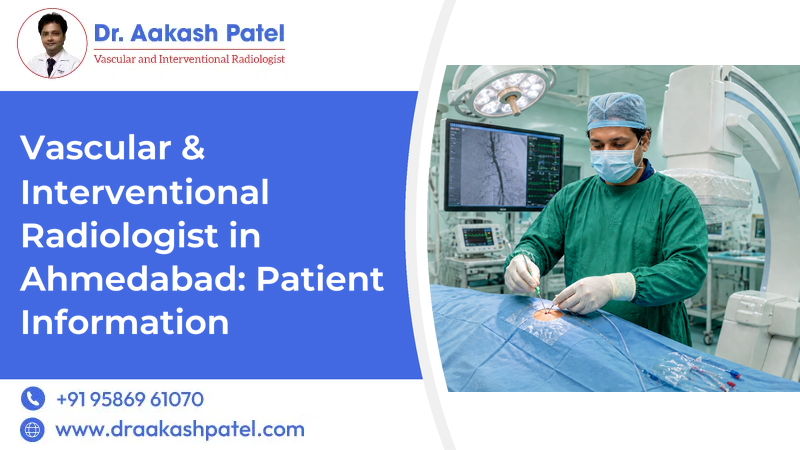
Vascular and Interventional Radiologist is a physician trained to use imaging modalities like ultrasound, fluoroscopy, CT scan, and MRI scans to perform diagnosis and treatments of a variety of diseases using minimally invasive procedures. Instead of opening up the body using large cuts, this kind of doctor works by making small incisions and then maneuvering catheters, needles, and other instruments to the targeted location. A Vascular & Interventional Radiologist in Ahmedabad is trained both to interpret medical images and to perform image-guided procedures. This involves years of specialised training, and the minimally invasive approach can mean a quicker recovery, smaller scars and a shorter hospital stay for many patients, although results vary from person to person.
Why the Role of an Interventional Radiologist Matters
Many patients are unaware of how wide the scope of interventional radiology really is. An Interventional Radiologist can treat conditions that span nearly every organ system in the body. From blocked arteries to uterine fibroids, from cancer tumors to chronic pain, the range of image-guided treatments available today is wide.
Some of the common areas where interventional radiology is used include:
- Vascular disease, including peripheral artery disease, deep vein thrombosis, and varicose veins
- Cancer therapies such as tumor embolization, chemoembolization, and radiofrequency ablation
- Women's health treatments like uterine fibroid embolization
- Men's health procedures including prostate artery embolization and varicocele treatment
- Pain management through nerve blocks and targeted injections
Each of these treatments is performed with image guidance, which lets the doctor see the needle or catheter in real time as it reaches the target area.
The Advantages of Minimally Invasive Treatment
When looking for an Interventional Radiologist in Ahmedabad, it helps to understand what minimally invasive treatment can and cannot offer. In addition to medical training and the use of imaging technology, the approach should be oriented towards patients. Image-guided treatment has several possible advantages. Firstly, many patients experience less pain than after open surgery. Blood loss, chances of developing infections and the use of general anesthesia are often reduced, and procedures usually occur under local anesthesia combined with light sedation. This is especially true for elderly individuals who do not handle open surgeries well and people suffering from heart and lung diseases. Another possible benefit is a shorter recovery. Many patients go home the same day or after an overnight stay, and many return to their usual activities soon after discharge, although this varies with the procedure and the person. This can matter for working adults and parents. Organ preservation is also considered an advantage. Treatments such as uterine fibroid embolization allow women to keep their uterus; prostate artery embolization is an alternative to traditional prostate surgery for some men, with its own benefits and risks.
What to Look for in an Interventional Radiologist
Patients may find it helpful to ask some practical questions before deciding where to be treated. When evaluating your options, consider the following factors:
- Recognised qualifications and training in interventional radiology
- Access to imaging equipment such as digital subtraction angiography and cone-beam CT
- A consultation process that explains all available options, not just interventional ones
- Strong follow-up care and accessibility before, during, and after the procedure
- Clear information on the possible risks, complications and expected results of the procedure
At our practice, Dr Aakash Patel (MBBS, DNB (Radiodiagnosis), FVIR) consults at KD Hospital, S.G. Highway, and explains the options, benefits and risks to patients looking for an Interventional Radiologist in Ahmedabad.
Conditions We Treat
We treat a range of different types of cases, and each one is assessed individually. Vascular blockages are dealt with through angioplasty and stenting procedures. For varicose veins, we use laser or radio frequency ablation, a procedure that usually takes less than an hour. Deep vein thrombosis may be treated using catheter-based procedures that help remove or dissolve clots in suitable patients. Interventional radiologists can also treat some cancers with procedures that deliver medication mainly to the affected area; ask the doctor whether this is suitable and offered for your condition. For women who suffer from excessive menstrual flow, pelvic pressure, and fibroids, we offer uterine fibroid embolization, while for men with an enlarged prostate, prostate artery embolization is one option, and its expected benefits and risks are discussed before treatment. Biliary drainage, kidney drainage (nephrostomy), placement of venous ports for chemotherapy, and biopsies under image guidance are some of the other procedures performed by an Interventional Radiologist.
Technology Used in Our Care
It is technology that has enabled the existence of modern interventional radiology, and we consider ourselves to be accountable for its use. We use equipment ranging from high resolution ultrasound to angiographic units to guide each procedure. Imaging technology is an essential part of how these procedures are planned and performed. If you wish to consult a Vascular & Interventional Radiologist in Ahmedabad, you can book an appointment at KD Hospital.
About Dr Aakash Patel
Choosing a specialist is an important decision, and at our clinic we aim to give you clear information to help you make it. Dr Aakash Patel holds MBBS, DNB (Radiodiagnosis) and FVIR qualifications and practises as a Vascular & Interventional Radiologist in Ahmedabad at KD Hospital, Vaishnodevi Circle, S.G. Highway. Dr Aakash Patel performs minimally invasive, image-guided procedures, ranging from vascular interventions to tumour treatments and uterine fibroid embolization. We believe that our role extends far beyond just performing medical procedures; we aim to listen to our patients' needs and concerns and provide a customized approach to treatment based on their conditions and requirements. Consultations are available Monday to Saturday, 10 AM to 6 PM.
Conclusion
Interventional radiology is a branch of medicine that has changed how many conditions are treated. The conditions for which intervention is required have become quite extensive and include diseases related to blood vessels and cancer, among others. The need for surgical intervention may sometimes seem daunting and difficult to handle, but interventional radiology offers image-guided diagnosis and treatment options that may avoid open surgery for some patients. When searching for an Interventional Radiologist in Ahmedabad, look for clear information about qualifications, the procedures offered, and their benefits and risks.
For more information about vascular and interventional care from an Interventional Radiologist in Ahmedabad, call us at +91 95869 61070 or book your appointment with Dr Aakash Patel to discuss your treatment options.
Frequently Asked Questions