
Table of Contents
- Introduction
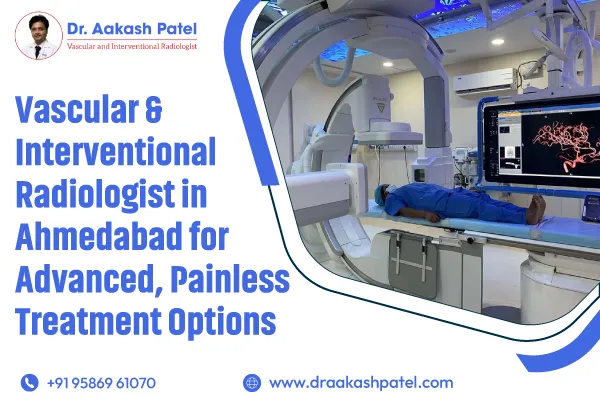
When vascular problems or complex disease demand precise, minimally invasive solutions, patients often hesitate at the thought of major surgery. Fortunately, modern medicine offers a far gentler alternative — interventional radiology. For people living in Ahmedabad and nearby areas, timely access to an experienced vascular and interventional radiologist in Ahmedabad can significantly improve recovery speed and overall comfort. When looking for a trusted vascular and interventional radiologist near me in Ahmedabad, you deserve a provider who combines deep expertise, cutting-edge imaging technology, and patient-centred care.
What Is Interventional Radiology?
Origins and Definition
Interventional Radiology (IR) — sometimes referred to as vascular and interventional radiology when focusing on the circulatory system — is a medical subspecialty where doctors use advanced imaging to both diagnose and treat disease with minimally invasive procedures. Unlike traditional surgery that cuts open the body to access organs or vessels, IR involves threading thin catheters, wires, or needles through small skin openings. Using real-time guidance from X-ray (fluoroscopy), ultrasound, CT or MRI, doctors navigate inside the body to reach the area of concern — be it a blocked artery, a tumour, or a bleeding vessel. This technique dramatically reduces physical trauma, lowers risk, and accelerates recovery compared to conventional open surgery.
How It Works — The Process
- A tiny puncture (often in the groin or wrist) is made under local anaesthesia or light sedation.
- A guidewire is inserted through the puncture and advanced into the vessel.
- A catheter (thin, flexible tube) is then guided over the wire to the target area — for example, a blocked artery or a tumour.
- Through this catheter, interventions can be delivered: balloons to widen vessels (angioplasty), stents to keep them open, coils or embolic particles to block blood flow to tumours or abnormal vessels, ablative probes to destroy abnormal tissue, or drugs directly to the site of pathology.
- Imaging guides every step, ensuring precision and minimal damage to surrounding healthy structures.
In other words: IR lets doctors reach deep-seated problems with millimetres-wide “access roads,” rather than opening up the body with large incisions.
Why Minimally Invasive Radiology Matters — Key Advantages and Clinical Value
Key Advantages Over Traditional Surgery
- Reduced Pain & Trauma: Because IR uses tiny punctures instead of large cuts, patients experience less postoperative pain, often requiring only minimal pain relief.
- Quicker Recovery and Reduced Hospitalization: A large number of interventional radiology procedures are performed as day-care treatments or require only brief hospital stays. Patients often resume normal activities in days instead of weeks.
- Lower Risk of Complications: Because the procedures are precise and minimally invasive, there’s less blood loss, less risk of infection, and less damage to healthy tissue.
- Highly Targeted Treatments: Doctors can deliver therapy — drugs, ablation, embolization — directly to the affected site, often with better outcomes than systemic treatments.
- Wide Applicability: IR isn’t limited to just vascular disease. It can address conditions in many organ systems — including tumour treatment, pain management, vascular disease, organ drainage, biopsies and more.
Impact on Patient Outcomes — Quality, Safety, Comfort
By combining imaging precision with minimally invasive techniques, patients benefit from safer procedures with faster, smoother recovery. This not only improves clinical outcomes but also enhances overall patient comfort and satisfaction. For patients with vascular conditions, chronic disease, or tumours — situations where traditional surgery might be risky or debilitating — IR offers a lifeline of hope: effective therapy without the burden of major surgery.
Common Vascular & Interventional Radiology Procedures
Here are some of the most typical procedures performed by a Vascular & Interventional Radiologist in Ahmedabad, including what they treat and how.
Ablation Therapies (Radiofrequency, Microwave, etc.)
For certain benign or malignant tumours — in liver, kidney, bone, thyroid, or other organs — ablative therapies (like Radiofrequency ablation (RFA) or microwave ablation) are used. A needle-like probe is inserted into the tumour under imaging guidance, and heat (or energy) destroys the abnormal tissue. Because of the precision, nearby healthy tissue is largely spared. For many patients, this option may replace or delay the need for open surgery.
Thrombolysis, Clot Removal and Aneurysm / Vascular Malformation Treatment
Clot-dissolving procedures or mechanical clot removal can restore blood flow in deep vein thrombosis (DVT), peripheral arterial disease (PAD), or acute vascular blockages. Treatment of aneurysms, arteriovenous malformations (AVMs), and vascular malformations through stent grafts, coil/embolization, or vessel reinforcement — often avoiding risky open surgery.
Diagnostic Procedures & Biopsies
IR also plays a critical role in diagnosing disease:
- Vessel imaging to detect blockages, stenosis, aneurysms or malformations.
- Image-guided biopsies (using ultrasound or CT guidance) to sample tissue from masses or organs for pathological analysis.
Because of the minimally invasive approach, diagnostic procedures are often safer and less stressful than surgical biopsies.
When to Consider Consulting a Vascular & Interventional Radiologist in Ahmedabad
If you experience any of the following, it may be time to seek expert IR care:
- Persistent leg pain, cramps, or heaviness — possible peripheral arterial disease or varicose veins
- Swollen, twisted veins or visible varicosities in the legs or arms
- Diagnosed tumour (e.g., in liver, kidney, bone) where surgery is risky or undesirable
- Blood clots (DVT), pulmonary embolism risk, or recurrent clotting issues
- Unexplained internal bleeding (e.g., gastrointestinal bleed), vascular malformations or aneurysms
- Need for targeted, minimal-invasive biopsy or drainage of fluid collection in organs
Search terms such as “vascular and interventional radiologist near me in Ahmedabad” or “vascular and interventional radiologist in Ahmedabad” become especially important when you need fast access to advanced, minimally invasive treatment options.
Why Choose Dr. Aakash Patel
When it comes to vascular and interventional radiology in Ahmedabad, only a select few specialists truly bring together advanced expertise, clinical precision, and a compassionate approach to patient care. Dr. Aakash Patel. With his deep training in interventional radiology, Dr. Aakash Patel delivers precise, minimally invasive care tailored to each patient’s needs. At his facility, patients benefit from modern imaging technology, a full spectrum of vascular and non-vascular interventional services, and a commitment to patient comfort and safety. Choosing Dr. Aakash Patel means choosing a partner dedicated to restoring your health through the safest, most effective treatment pathways.
Conclusion
Minimally invasive, imaging-guided treatments offered by a Vascular & Interventional Radiologist in Ahmedabad represent a major advancement in modern medicine. Patients benefit from reduced pain, lower risk, faster recovery, and highly precise therapy. When led by a capable, experienced professional such as Dr. Aakash Patel, the path to recovery becomes smoother and more comfortable. If you or a loved one face vascular issues, tumours, or complex vascular conditions — don’t opt for traditional surgery without exploring IR. This advanced approach delivers excellent medical outcomes with minimal disruption to daily life.
Book an appointment with Dr. Aakash Patel today to explore your treatment options. Call +91 95869 61070 or Book your appointment Today.