Table of Contents
- Introduction
Varicose veins are a widespread vascular condition affecting millions of people across different age groups. Once considered only a cosmetic concern, this condition is now recognized as a progressive medical disorder that can severely impact daily comfort, mobility, and long-term vascular health. With changes in lifestyle, prolonged sitting or standing, and rising work-related physical strain, the incidence of venous disease is steadily increasing. As a result, more patients today actively search for varicose veins treatment near me to find suitable treatment options.
Varicose veins treatment now often uses non-surgical, image-guided procedures, which usually involve a shorter recovery and less discomfort than traditional surgery. In cities like Ahmedabad, patients have access to interventional care that treats the faulty vein causing the problem rather than only the symptoms. Under the guidance of Dr. Aakash Patel, patients receive a detailed diagnostic evaluation and treatment using minimally invasive, image-guided techniques. This guide explains the medical foundation of varicose vein disease, its symptoms and risks, and the non-surgical options available today.
Understanding Varicose Veins and Venous Disease
What Are Varicose Veins?
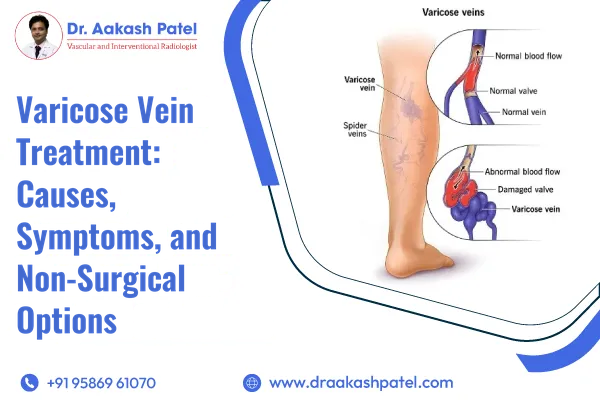
Varicose veins develop when the valves inside the veins of the legs stop functioning properly. These valves normally help blood flow upward toward the heart against gravity. When they weaken, blood begins to collect within the veins, leading to increased pressure. Over time, this pressure causes the veins to stretch, twist, and become visibly enlarged beneath the skin. The affected veins often appear dark blue or purple and may feel raised, warm, or tender to touch.
Although early-stage varicose veins may appear mild, the underlying problem is circulatory. In some people, venous pressure continues to rise over time, which can lead to gradual changes in surrounding tissues and skin.
What is Varicose Vein Disease?
What is varicose vein disease? It is a chronic disorder of the venous system marked by persistent backward flow of blood in the leg veins due to valve failure. This abnormal circulation produces sustained venous hypertension that gradually damages vein walls, skin tissue, and surrounding structures. The disease exists on a wide spectrum ranging from cosmetic spider veins to advanced stages involving ulcers, bleeding, skin thickening, and in rare cases, thrombotic complications. Venous disease does not usually reverse on its own, and medical care can help control its progression.
Causes and Risk Factors
The development of varicose veins is influenced by both biological and lifestyle-related factors that progressively weaken vein structure and function.
- Primary Cause: Valve incompetence within the superficial venous system. Once valve failure begins, gravitational forces continuously push blood downward, raising internal venous pressure and distending the vein.
- Contributing Risk Factors: Age-related degeneration of veins, genetic inheritance, hormonal fluctuations, pregnancy, obesity, and occupational habits involving long periods of immobility all raise the risk of venous disease. Individuals who stand or sit for many hours without adequate movement experience impaired calf muscle pumping, which is essential for healthy venous return.
Symptoms and Medical Complications
Common Clinical Symptoms: Symptoms of varicose veins vary in severity depending on the stage of disease. Patients often report persistent leg heaviness, dull aching pain, swelling near the ankles, itching around the affected veins, night cramps, and visible bulging veins that worsen toward the end of the day. Symptoms typically intensify with prolonged standing and improve temporarily when the legs are elevated.
Potential Complications: In some patients, venous disease may progress to more serious medical problems. Long-standing venous hypertension can lead to skin discoloration, hardening of subcutaneous tissue, venous eczema, and eventually non-healing venous ulcers near the ankle region. Fragile superficial veins may rupture, causing spontaneous bleeding. Some patients also develop superficial vein thrombosis that presents with severe pain and localized swelling. These complications affect quality of life, so it is worth seeing a doctor if such symptoms develop.
Benefits, Features, and Role of Varicose Vein Treatment
Varicose veins treatment is not only cosmetic. It may relieve symptoms, improve blood flow in the leg, and lower the risk of some long-term complications.
- Medical and Functional Benefits: Many patients notice relief from pain, less leg swelling, easier walking, and less fatigue, although results vary. Long-term control of venous hypertension may lower the risk of ulcers, skin damage, and secondary infections. Improved circulation may also support overall limb health and functional endurance.
- Key Features of Non-Surgical Therapy: Current varicose veins treatment in Ahmedabad is built on image-guided interventional techniques performed through needle-sized access rather than surgical incisions. These procedures rely on ultrasound guidance to target diseased veins while preserving healthy venous pathways. Treatment is usually delivered under local anesthesia, and post-procedure discomfort is usually mild. Many patients return to routine activity within a short time, so these therapies can suit both working professionals and elderly individuals.
- Importance in Preventive Vascular Care: Venous disease is progressive in nature. Treatment at a suitable stage can help slow disease progression and lower the risk of complications. Consulting varicose veins treatment doctors allows treatment to be considered before skin damage, ulcer formation, and chronic pain develop.
Complete Topic Breakdown: Diagnosis and Evaluation
A careful diagnosis is the basis of varicose veins treatment. Visual inspection alone cannot determine the extent of venous reflux or involvement of deeper veins.
Duplex Ultrasound Examination: The primary diagnostic tool is duplex color Doppler ultrasound. This non-invasive test evaluates blood flow direction, identifies malfunctioning valves, maps venous anatomy, and detects hidden obstructions or clots. Based on ultrasound findings, a patient-specific treatment plan is developed rather than a generic approach.
Disease Classification and Treatment Planning: Venous disease is medically classified into stages according to symptom severity and skin involvement. This clinical grading guides treatment selection, whether conservative management or interventional therapy is appropriate. Patients seeking doctors for varicose vein treatment in Ahmedabad usually undergo duplex scanning before finalizing interventional therapy.
Non-Surgical Varicose Vein Treatment Options
Varicose veins treatment has largely shifted toward minimally invasive interventional methods that treat the faulty vein from within.
- Endovenous Laser Treatment (EVLT): Laser energy is delivered inside the diseased vein through a thin fiber guided by ultrasound. The heat seals the abnormal vein, which is gradually absorbed by the body. Blood naturally reroutes into healthy veins, which can improve circulation.
- Radiofrequency Ablation (RFA): RFA works on a similar principle using controlled radiofrequency energy to close the affected vein. It produces uniform heat delivery, and studies report symptom relief and good long-term results in many patients.
- Medical Adhesive Closure: This technique uses a specialized medical glue to seal defective veins without heat. It is suitable for selected patients, and most can walk soon after the procedure.
- Ultrasound-Guided Sclerotherapy: A medicated solution is injected directly into smaller varicose and spider veins to shrink and close them. It is often used as a complementary procedure to laser or radiofrequency therapy.
Patients searching for varicose veins treatment near me often ask about these techniques because they usually avoid surgical incisions, hospital admission, and long downtime.
Life After Treatment and Long-Term Care
Following non-surgical varicose veins treatment, many patients resume normal work and walking within one to two days, although this varies. Mild tightness or bruising may appear temporarily and usually settles. Follow-up ultrasound checks vein closure and monitors venous flow in the surrounding circulation.
Long-term vein health depends on maintaining active movement, weight control, and periodic venous evaluation in individuals with genetic predisposition. While treated veins usually remain sealed, new varicose veins may appear over time due to inherited valve weakness. Regular assessment by doctors for varicose vein treatment in Ahmedabad supports early intervention and sustained symptom control.
Varicose Veins Treatment in Ahmedabad: Patient Perspective
Access to varicose veins treatment in Ahmedabad has expanded with the availability of vascular imaging and interventional facilities. Patients can have ultrasound-based diagnosis, day-care procedures, and structured follow-up. The shift from surgical stripping to image-guided therapy has generally shortened recovery time compared with open surgery, and patients often find it less stressful.
Dr. Aakash Patel combines duplex ultrasound evaluation with image-guided interventional techniques. His approach focuses not only on closing faulty veins but also on improving venous circulation and lowering the chance of recurrence. Follow-up is part of this plan, as results vary from person to person.
Questions to Ask Before Varicose Vein Treatment
When consulting varicose veins treatment doctors, patients may ask about the doctor's qualifications, the tests needed, the treatment options, and the follow-up plan. Diagnostic mapping and interventional closure are both done under ultrasound guidance. Patients seeking doctors for varicose vein treatment in Ahmedabad can ask how the benefits, risks, and expected recovery apply to them.
Understanding the plan before treatment helps patients make an informed decision. The doctor should explain what to expect, including the possibility of recurrence.
About Dr. Aakash Patel
Dr. Aakash Patel is a vascular and interventional radiologist (MBBS, DNB Radiodiagnosis, FVIR) at KD Hospital, Ahmedabad. He offers each patient a treatment plan based on ultrasound mapping of the veins and individual disease severity. His approach considers safety, appearance, symptom relief, and long-term vein health. Consultations include an explanation of the options, benefits and risks, and follow-up is provided after treatment to monitor recovery.
Conclusion
Varicose veins are a progressive circulatory disorder that can, in some people, develop into a more troublesome medical condition over time. Patients now have access to non-surgical, image-guided therapies that may improve circulation and support long-term venous health. Understanding what varicose vein disease is, recognizing early symptoms, and consulting varicose veins treatment doctors can help prevent complications such as ulcers, bleeding, and chronic pain. For individuals seeking varicose veins treatment in Ahmedabad, Dr. Aakash Patel provides image-guided techniques that aim to relieve symptoms and improve mobility in daily life; results vary from person to person.
For varicose veins treatment near me, you can consult Dr. Aakash Patel. Call +91 95869 61070 or Book your appointment to discuss your options.
FAQs