

Table of Contents
- Introduction
Key Takeaways
- Uterine fibroids can affect fertility, but their impact varies based on size and location.
- Not all fibroids cause infertility; many women conceive with fibroids present.
- Uterine Fibroids Treatment in Ahmedabad should be personalized based on individual assessments.
- Submucosal fibroids are more likely to interfere with pregnancy than subserosal ones.
- Discussing reproductive goals with a healthcare provider is crucial before any fibroid treatment decisions.
Dr Aakash Patel is a leading provider of minimally invasive interventional radiology services. For women planning a family, discovering uterine fibroids can naturally raise questions about fertility and pregnancy. Uterine Fibroids Treatment in Ahmedabad should be based on the individual fibroid's size, number, location, symptoms, and its effect on the uterine cavity rather than on the diagnosis alone. Fibroids can sometimes affect fertility and pregnancy, but having a fibroid does not automatically mean that pregnancy will be difficult.
What Are Uterine Fibroids?
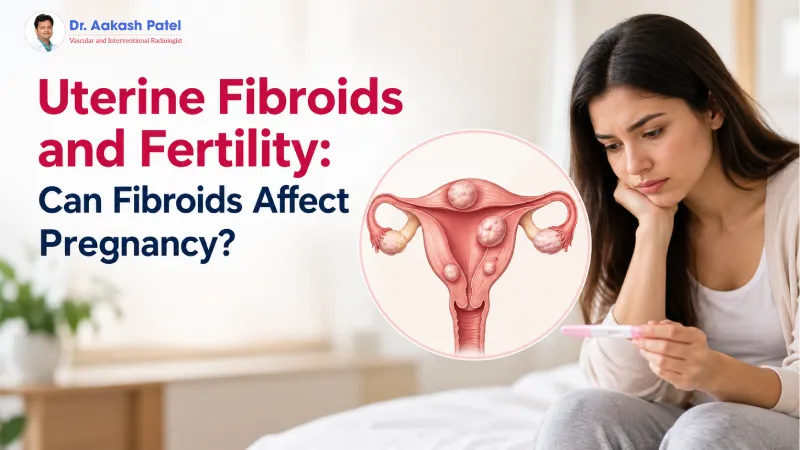
Uterine fibroids are growths that develop in the muscle of the uterus. They are generally benign and may occur without causing noticeable symptoms. Some women may experience heavy menstrual bleeding, pelvic pain or pressure, while others discover fibroids during an examination or imaging test.
The effect of a fibroid on reproductive health can vary significantly. The location and relationship of a fibroid to the uterine cavity can matter more than simply knowing that a fibroid is present.
Can Fibroids Affect Fertility?
Fibroids can be associated with infertility, but they are not always the reason a woman has difficulty becoming pregnant. The American College of Obstetricians and Gynecologists notes that fibroids may cause infertility, while other causes are more common and should also be investigated.
Research reviewed by the American Society for Reproductive Medicine also indicates that evidence is not strong enough to conclude that fibroids in general reduce the likelihood of achieving pregnancy. However, fibroids that distort the uterine cavity are a particularly important consideration because the cavity plays a role in implantation and early pregnancy development.
This means that treatment decisions should not be based only on fibroid size. A proper assessment looks at how the fibroid affects the uterus and whether it is likely to interfere with reproductive goals.
Which Fibroids May Have More Impact on Pregnancy?
Fibroids can develop in different locations within or around the uterus. Their position can influence how they affect fertility and pregnancy.
Submucosal fibroids extend toward the inside of the uterine cavity. Because they can distort the cavity, they may have a greater reproductive impact than fibroids that do not affect the cavity. ASRM reports fair evidence that treatment of cavity-distorting fibroids can improve clinical pregnancy outcomes in appropriately selected patients.
Intramural fibroids develop within the muscular wall of the uterus. Their reproductive effect is less straightforward and may depend on their relationship with the endometrial cavity.
Subserosal fibroids grow toward the outside of the uterus. Current evidence is insufficient to conclude that removing subserosal fibroids improves fertility.
Can You Get Pregnant With Fibroids?
Yes, pregnancy can occur in women who have uterine fibroids. The presence of fibroids does not automatically mean infertility or that pregnancy will be unsafe. ACOG states that many women are able to become pregnant after treatment when fibroids are considered to be contributing to fertility problems.
At the same time, pregnancy planning should take the fibroid's characteristics into account. Depending on their location and size, fibroids may be associated with problems related to conception or pregnancy. A woman who is already known to have fibroids and is planning a pregnancy may therefore benefit from discussing her reproductive goals with her treating doctor.
How Are Fibroids Evaluated Before Pregnancy?
Before deciding whether treatment is necessary, we first need to understand the uterine anatomy. Imaging can help identify the number, size, location, and relationship of fibroids to the uterine cavity.
Ultrasound is commonly used to evaluate uterine anatomy, while pelvic MRI may be used when more detailed characterization is needed. ASRM notes that ultrasound can assess the uterus and surrounding adnexa, while MRI can provide additional information about uterine and fibroid anatomy.
A fertility-focused assessment may consider:
- Fibroid size and number
- Location of each fibroid
- Whether the uterine cavity is distorted
- Current symptoms
- Previous fertility or pregnancy history
- Other possible causes of infertility
- Whether future pregnancy is an immediate priority
What Function Does Uterine Fibroid Embolization Serve?
Uterine artery embolization, abbreviated as UAE or UFE, is a minimally invasive procedure that involves the injection of small particles in the blood vessels that supply the uterus so as to decrease the flow of blood to fibroids.
Fertility issues in women who have considered Uterine Fibroid Embolization (UFE) Treatment in Ahmedabad are key issues that should be addressed since according to ACOG, there is no enough information on how uterine artery embolization impacts future pregnancies.
Pregnancy after UFE has been recorded but still there is not enough evidence regarding fertility and pregnancy outcome. According to a systematic review, pregnancy can occur after UAE despite having some limitations on the evidence base.
For this reason, women who strongly prioritize future fertility should discuss all available fibroid treatment options and their reproductive implications before choosing a procedure.
Does Fibroid Treatment Improve Fertility?
Fibroids should be considered for treatment if one thinks they are causing the problem, but treatment for all fibroids regardless of their existence is not supported by scientific research.
It has been observed that ASRM states that there is fair evidence that myomectomy may increase chances of conception in women with cavity distorting fibroids. On the other hand, there is no evidence that removal of all types of fibroids increases fertility.
What Should Women Consider Before Choosing UFE?
A fertility discussion should happen before treatment, particularly for women who plan to have children. During consultation, it can be useful to discuss:
- Whether pregnancy is a current or future goal
- Whether the fibroid distorts the uterine cavity
- Why treatment is being recommended
- Which treatment options are suitable for the specific fibroid
- What is known about fertility after the proposed treatment
- Whether consultation with a fertility specialist is appropriate
For Uterine Fibroids Treatment in Ahmedabad, a personalized evaluation can help distinguish between fibroids that may require intervention and those that may simply need observation.
Why Choose Us
At Dr Aakash Patel, we focus on individualized assessment and minimally invasive treatment planning. Our approach begins with understanding the patient's symptoms, imaging findings, fibroid characteristics, and reproductive goals. We believe treatment decisions should be discussed clearly, especially when future pregnancy is important. Our interventional radiology expertise allows us to evaluate whether a minimally invasive option such as UFE may be appropriate for the individual clinical situation.
Conclusion
The presence of uterine fibroids can cause problems concerning fertility and pregnancy in certain women; however, their effect varies greatly from woman to woman. In particular, distorted uterine cavity fibroids require more detailed consideration than other fibroid categories, whose impact on fertility and pregnancy has not yet been proven. (ASRM) It is necessary to take into account a woman's complaints, the location of fibroids, her desire to have children, and the assessment of her reproductive abilities when determining the course of treatment.
It is very important to discuss pregnancy planning in case of the choice of Uterine Fibroid Embolization Treatment in Ahmedabad as there is no strong evidence on this matter.
Looking for personalized guidance for fibroids and future pregnancy? Contact Dr Aakash Patel to discuss your condition, imaging findings, and suitable treatment options. For more information about Uterine Fibroids Treatment in Ahmedabad, call us at +91 95869 61070 or Book Your Appointment.
Frequently Asked Questions
Uterine Fibroids Fibroids and Fertility Fibroids and Pregnancy UFE Uterine Fibroid Embolization Fibroid Treatment Uterine Health Fertility Care Minimally Invasive Treatment Ahmedabad
Scan the QR to call