
Table of Contents
- Introduction
Key Takeaways
- Interventional Radiology uses imaging to treat many conditions through tiny incisions, offering a less invasive alternative to traditional open surgery in suitable patients.
- Many patients have shorter hospital stays, faster recovery, less pain, and fewer complications compared with conventional surgical approaches, although results vary.
- The scope of Interventional Radiology in Ahmedabad covers vascular disease, cancer therapy, women's health, men's health, pain management, and much more.
- Procedures like uterine fibroid embolization, prostate artery embolization, and tumor ablation aim to preserve organ function; results vary from person to person.
- Dr Aakash Patel (MBBS, DNB Radiodiagnosis, FVIR) offers image-guided, minimally invasive treatments at KD Hospital, Ahmedabad.
Modern medicine has evolved far beyond the era when every serious diagnosis meant a long hospital stay, large surgical incisions, and weeks of painful recovery. Today, patients have access to a specialty that blends imaging technology with targeted therapy, allowing doctors to treat complex conditions through pinpoint-sized openings in the skin. This specialty is called Interventional Radiology, and it is changing how patients in Gujarat and across India receive care. If you or a loved one is searching for Interventional Radiology in Ahmedabad, understanding what this field offers, how it works, and why it matters is the first step toward making an informed decision about your health. At Dr Aakash Patel's practice, we combine specialist training with image-guided technology to deliver care that is careful and patient-centered. Our aim is simple: to give you the right care for your condition with the least possible disruption to your life.
What Is Interventional Radiology?
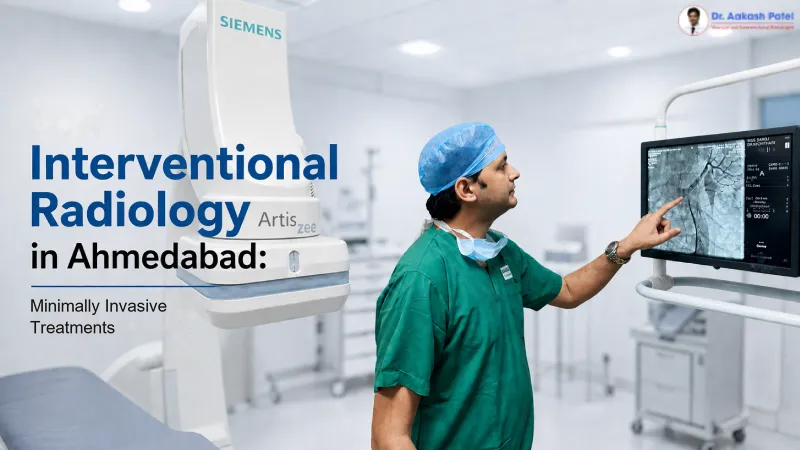
Interventional Radiology is a medical subspecialty that uses imaging techniques, such as ultrasound, fluoroscopy, CT scans, and MRI, to guide tiny instruments through the body to diagnose and treat a wide range of conditions. Instead of traditional open surgery, interventional radiologists work through small punctures, often no larger than a few millimetres, using catheters, needles, and wires that travel through blood vessels or directly into organs. This approach can offer real benefits for patients. There is typically no need for large incisions, general anaesthesia is often avoided, hospital stays are shorter, and recovery times are often reduced. For some conditions that once required major surgery, Interventional Radiology now provides a less invasive alternative for suitable patients.
Why Interventional Radiology in Ahmedabad Is Gaining Popularity
Ahmedabad has a large number of healthcare facilities in western India. Minimally invasive surgery in Ahmedabad has been gaining popularity in recent years. People have become knowledgeable about different types of minimally invasive procedures, which require specialists who know how to perform these surgeries. The emergence of interventional radiology in Ahmedabad has come because of such awareness. There are numerous reasons why interventional radiology has become more prevalent in Ahmedabad. The first reason is the availability of healthcare infrastructure in Ahmedabad. There are many hospitals in Ahmedabad that have been equipped with imaging technologies. In addition, patients can get treatment closer to home without travelling to other cities. Finally, there are many specialists who are capable of performing various minimally invasive operations in Ahmedabad.
Common Conditions Treated Through Interventional Radiology
There are several medical conditions that can now be treated using interventional radiology techniques. Some of these include the following: Vascular conditions are among the most common conditions treated with interventional radiology. Vascular issues such as clots in arteries and veins, deep vein thrombosis, varicose veins, peripheral artery disease, and aneurysms can be treated using catheterization techniques. Angioplasty and stenting involve the opening up of constricted blood vessels through catheterization to allow blood flow freely. Interventional radiology techniques are also used to treat various forms of cancer. Methods like tumor embolization, radiofrequency ablation, and microwave ablation are used to treat a tumor located in the lung, liver, or kidney directly. Chemoembolization involves the delivery of chemotherapy drugs directly into the tumor site to enhance their efficacy while minimizing their impact on healthy body parts. Interventional radiology techniques also serve a critical role in treating reproductive system disorders. The procedure called uterine fibroid embolization, also referred to as UFE, can help women with bulky uterus due to fibroids reduce the intensity of their menstrual flows and may relieve the pain they experience during this period.
How a Typical Procedure Works
It is natural for patients to get anxious before an invasive procedure but understanding what really goes on can help you calm down. Most interventional procedures start from consultation, wherein Dr Aakash Patel studies the patient's history, images, and complaints. Having developed a treatment plan, it becomes possible to schedule the procedure at the facility with special imaging equipment. On the procedure day, the patient is given anesthesia and sedation so that he feels relaxed. A tiny puncture is then created either in the wrist, groin or directly into the target tissue. With the help of imaging technology, we guide our devices to where they need to be. The procedure may involve stenting, drug administration, ablation or embolization. Many patients leave the facility several hours after the procedure, either on the same day or after an overnight stay. Many patients return to their usual activities within a few days after Interventional Radiology, although recovery varies.
The Advantages of Choosing Minimally Invasive Treatment
The advantages of image-guided treatment are not limited to avoiding the large scar. For many patients there may be less bleeding and a lower risk of some complications, such as infection, than with open surgery; all procedures carry some risk. General anesthesia may be avoided, which is especially significant for older patients or people with cardiovascular problems who cannot stand lengthy operations. The patient usually spends fewer days in hospital, resulting in less disruption within their families. The post-treatment recovery period is often shorter; there is usually little need for physical therapy, and many patients recover more quickly than after open surgery. This aspect has great importance for working adults and busy parents. There is also a benefit regarding the quality of patient life. Uterine fibroids can be treated without removal of the uterus, prostate artery embolization aims to preserve sexual function, and tumor ablation aims to spare healthy organ tissue. Respect towards the body’s physiology is one of the hallmarks of Interventional Radiology.
Technology Used in Interventional Radiology
Interventional treatment involves not only diagnostic imaging but also clinical judgement. Digital subtraction angiography offers detailed images of your blood vessels. With cone-beam CT, the procedure can be planned in 3D. Ultrasound helps to guide the insertion of needles into small targets. Such technologies, used by a trained clinician, make procedures possible today that were not available in the past. Patients looking for Interventional Radiology in Ahmedabad can access these imaging tools at hospitals in the city.
Preparing for Your Consultation
Should you decide to go for a consultation, there are some basic guidelines you can follow to make sure that you make the most of your time. Bring along any medical history and previous images you may have, as well as an updated medication list. Also prepare a brief overview of your complaints, the duration of the condition, and any previous treatment attempts. An ideal consultation session would be one where both parties listen to each other equally and where every possibility, including those which do not require intervention, are explored in an honest and transparent manner. This is the philosophy we abide by in our practice.
About Our Practice
Deciding on a specialist for an interventional procedure is an important decision regarding your health, and we understand its significance. When choosing an Interventional Radiology specialist in Ahmedabad, patients often consider qualifications, clear communication, and the imaging facilities available. Dr Aakash Patel (MBBS, DNB Radiodiagnosis, FVIR) performs interventional procedures at KD Hospital, Ahmedabad, ranging from vascular treatments to the treatment of tumours and women's conditions. Each of our patients is carefully explained the nuances of treatment, including the benefits and risks, and we always find an individual approach to each case, discussing it thoroughly before proceeding to treatment. Our team treats people and their cases with respect and tries to be available at each stage of the treatment process.
Conclusion
Interventional Radiology has changed contemporary medicine with the introduction of image-guided, minimally invasive treatment procedures for the patient. Regardless of whether you have any vascular conditions, cancerous growths, uterine fibroids, or a large prostate, there are now many procedures that can be carried out on you without having to undergo an invasive surgery. When looking for a solution to a medical problem, it is important to choose the right doctor along with the most suitable procedure. At our clinic, Dr. Aakash Patel explains your condition and uses radiological imaging techniques to guide treatment.
For more information about minimally invasive treatments and Interventional Radiology in Ahmedabad, call us at +91 95869 61070 or book your appointment with Dr Aakash Patel to discuss your condition.
Frequently Asked Questions