

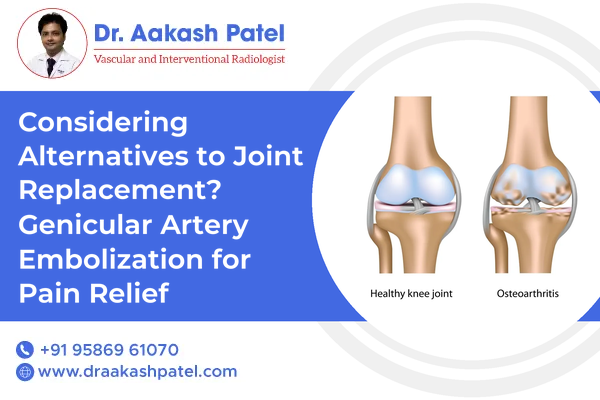
Chronic knee pain caused by osteoarthritis often affects mobility, joint function, and long-term quality of life. As the condition progresses, inflammation inside the joint leads to stiffness, swelling, and reduced ability to walk or climb stairs. Traditionally, patients struggling with advanced knee osteoarthritis or persistent chronic knee pain have been guided toward long-term medications, repeated injections, or eventual knee replacement surgery. While joint replacement can be effective, many individuals wish to delay or avoid surgery due to medical, personal, or lifestyle considerations.
In recent years, a minimally invasive option called Genicular Artery Embolization (GAE) has emerged as an alternative option for pain relief. This therapy reduces abnormal blood flow around knee structures and targets the inflammation that drives chronic discomfort. Interventional radiologists such as Dr. Aakash Patel offer this image-guided therapy, which may help reduce pain in suitable patients. For those searching for targeted, non-surgical options—especially individuals looking for genicular artery embolization treatment in Ahmedabad—this procedure may help improve symptoms, although results vary from person to person.
Understanding Osteoarthritis and Why Knee Pain Worsens
What Happens in Knee Osteoarthritis
As cartilage in the joint wears away, bones begin to rub against each other, causing pain and inflammation. This process makes knee osteoarthritis progressively more difficult to manage. Reduced cartilage also accelerates tissue damage, limiting the ability to bend or straighten the knee comfortably.
Role of Inflammation in Pain
Inflammation plays a major role in the cycle of pain, stiffness, and swelling. As abnormal blood vessels form around the knee joint, they contribute to prolonged irritation. This is why advanced chronic knee pain often does not respond to simple pain medication.
Why Traditional Treatments May Fall Short
While physiotherapy, injections, and medication can provide relief, they may not effectively address blood-vessel-related inflammation. This is where Genicular Artery Embolization becomes relevant, as it aims to reduce blood flow to inflamed tissue and may reduce pain in selected patients.
What Is Genicular Artery Embolization?
A Minimally Invasive Non-Surgical Technique
Genicular Artery Embolization (GAE) is a catheter-based procedure designed to reduce abnormal blood flow to the knee’s inflamed tissues. A microcatheter is guided through arteries supplying the knee, and tiny particles are released to block problematic vessels. This aims to reduce inflammation and may help relieve pain originating from osteoarthritis of the knee.
How the Procedure Works
A small puncture is made, usually at the wrist or groin. Under X-ray guidance, the catheter is navigated to the genicular arteries. Once positioned, targeted particles are released to decrease the inflammation-driving circulation. Over time, many patients notice improved function and reduced discomfort; results vary. Possible risks include bruising at the puncture site and temporary skin discolouration over the knee, and the evidence is still developing.
Why It Suits Knee Osteoarthritis Patients
Unlike surgical options, GAE does not involve joint removal or implants, and recovery is usually shorter. It is an option for individuals wanting to delay knee replacement while still seeking non-surgical knee pain relief.
Benefits, Features & Importance of Genicular Artery Embolization
Key Benefits
- May help reduce pain in moderate to severe knee osteoarthritis
- Usually a short recovery period; results vary
- Targets abnormal blood flow linked to knee inflammation
- Non-surgical, outpatient-based, image-guided technique
- Suitability for patients not ready for or unable to undergo joint replacement
Features of This Treatment
- Catheterization performed under high-resolution imaging
- Micro-particles designed for precise vessel targeting
- Ability to treat localized areas without affecting the entire knee
- Considered for both early and advanced knee osteoarthritis
Impact on the Future of Knee Pain Care
With more patients seeking alternatives to major surgery, Genicular Artery Embolization is becoming one component of joint preservation strategies. Specialists like Dr. Aakash Patel use this therapy to help suitable individuals improve mobility and reduce dependency on pain medications.
Complete Topic Breakdown: Who Should Consider Genicular Artery Embolization?
Ideal Candidates
Patients with chronic knee pain who have tried conservative measures yet still face functional difficulty may benefit. This includes those with:
- Persistent swelling or stiffness
- Movement restrictions caused by knee osteoarthritis
- Reduced daily activity due to pain
- Desire to postpone knee replacement
When It Works Best
GAE is generally reported to work better for patients with mild to moderate cartilage wear, but it may also benefit those with long-standing chronic knee pain who may not currently qualify for surgery.
When It May Not Be Recommended
Individuals with active infections or severe arterial disease may require alternate approaches. The decision is always made through detailed consultation with a doctor such as Dr. Aakash Patel.
Step-by-Step Procedure Overview
- Pre-Procedure Evaluation: A detailed clinical assessment, medical history review, and imaging are conducted to determine severity of knee osteoarthritis. The goal is to understand the exact regions of inflammation.
- Day of Treatment: The patient lies comfortably as a local aesthetic is applied. A tiny puncture allows catheter insertion into the artery.
- Embolization Phase: The catheter is directed to the genicular arteries. Micro-particles are delivered until blood flow to inflamed areas decreases.
- Completion and Monitoring: Once completed, the catheter is removed, and a small bandage is placed. Patients can usually walk within hours and return home the same day.
- Recovery: Mild soreness may occur, and most daily activities can be resumed gradually. Pain relief, when it occurs, often begins within days to weeks and may continue to improve over months.
Clinical Results Reported in Studies
- Pain Reduction Outcomes: Studies report that many patients undergoing genicular artery embolization have a drop in pain levels, with better walking capacity and less stiffness; results vary between individuals.
- How It Compares to Other Treatments : Unlike injections—which must be repeated—or medicines with systemic effects, GAE offers targeted treatment whose benefit may last longer in some patients.
- Longevity of Relief : Research reports that some patients maintain pain relief for extended periods following treatment. This positions GAE as a possible step before considering major surgical intervention.
Why Genicular Artery Embolization Is Being Considered
- Non-Surgical Pathway: As more individuals seek minimally invasive treatments for knee osteoarthritis, GAE is being studied as a practical option.
- Preservation of Joint Structure: Unlike knee replacement, no tissue is removed or replaced. The procedure aims to reduce inflammation while preserving the joint.
- Suitable for Diverse Age Groups: Younger individuals wanting to delay surgery and older adults unable to undergo joint replacement may both be considered.
- Availability in Ahmedabad: At KD Hospital, S.G. Highway, genicular artery embolization in Ahmedabad gives patients seeking non-surgical knee pain relief an option close to home.
Consulting Dr. Aakash Patel
Dr. Aakash Patel (MBBS, DNB Radiodiagnosis, FVIR) is an interventional radiologist at KD Hospital, Vaishnodevi Circle, S.G. Highway, Ahmedabad. His work with minimally invasive therapies such as genicular artery embolization aims to help patients improve mobility without unnecessary surgical intervention. He carries out a detailed evaluation and explains the options, benefits and risks to individuals seeking pain relief and better quality of life. Procedures are image-guided, using catheters and wires under X-ray fluoroscopy, and follow-up looks at long-term wellbeing.
Conclusion
Chronic knee pain caused by knee osteoarthritis does not always need to lead directly to joint replacement. Options like genicular artery embolization may provide relief by targeting inflammation under image guidance. For patients struggling with mobility or activity limitations due to chronic knee pain, this minimally invasive technique is a practical alternative to discuss with a doctor. With interventional radiologists like Dr. Aakash Patel, individuals seeking genicular artery embolization treatment in Ahmedabad can discuss whether the procedure may help their movement; results vary. With thoughtful diagnosis and appropriate vascular intervention, many patients find knee pain becomes more manageable.
For a consultation, call +91 9586961070 or Book an Appointment.
FAQs