

Table of Contents
- Introduction
Key Takeaways
- Recognize symptoms of dialysis fistula problems like swelling and redness for timely intervention.
- Fistula angioplasty is a minimally invasive treatment option available in Ahmedabad for narrowed vessels.
- Understanding when to seek best fistula treatment in Ahmedabad is crucial for maintaining dialysis access.
- Regular monitoring of your fistula condition can prevent complications and ensure effective treatment.
- Seek immediate medical assessment if you experience sudden loss of fistula function during dialysis.
Is your dialysis fistula swollen, painful, or becoming difficult to use during dialysis? Changes in blood flow can affect your dialysis access and may need medical attention. At Dr Aakash Patel, we provide Fistula Treatment in Ahmedabad, focusing on minimally invasive fistula angioplasty for narrowed or blocked dialysis access. Understanding the warning signs and available treatment can help you seek care before access problems become more serious.
What Are the Warning Signs of Dialysis Fistula Problems?
A dialysis fistula creates a reliable vascular access point for patients receiving hemodialysis treatment. When the connected blood vessel becomes narrowed or blocked, dialysis may become difficult.
At our Ahmedabad practice, we assess patients reporting changes around their dialysis fistula.
Watch for these warning signs:
- Swelling around the fistula: The access area appears unusually swollen.
- Redness: Visible changes in skin colour near the fistula.
- Bulging veins: Veins around the access become more prominent.
- Arm swelling: The arm containing the fistula becomes swollen.
- Dialysis difficulties: The fistula becomes harder to use during treatment.
Our team also considers changes in blood pressure and other clinical findings during assessment.
A sudden loss of the usual fistula vibration or complete loss of access function needs urgent medical assessment.
Not every symptom indicates a blockage. However, delaying evaluation may make an existing access problem harder to manage.
Why Does a Dialysis Fistula Become Blocked?
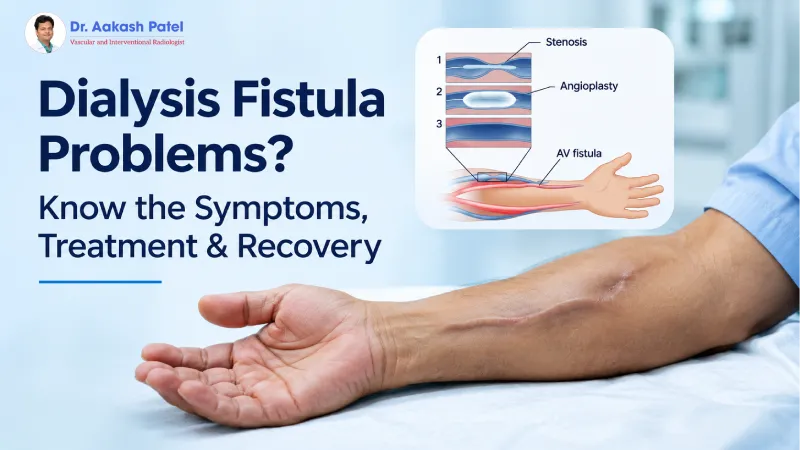
A dialysis fistula is formed through surgery by connecting an artery directly to a vein, usually in the patient’s arm. This connection provides the blood flow needed for regular hemodialysis. Over time, narrowing may develop within the blood vessels involved in dialysis access. This narrowing is called stenosis and can restrict blood movement through the fistula.
In some cases, blood clots may further affect the access.
At KD Hospital, Ahmedabad, we assess fistulas with suspected narrowing or blockage and consider whether image-guided intervention can improve blood flow.
Our approach to Dialysis Fistula Treatment in Ahmedabad focuses on the specific access problem rather than recommending the same treatment for every patient. The main objective is to preserve usable dialysis access whenever medically possible.
How Does Fistula Angioplasty Treat a Blocked Fistula?
Patients with a narrowed dialysis fistula may not always require an open surgical procedure.
We offer fistula angioplasty, a minimally invasive intervention that uses a balloon catheter to widen the narrowed part of the blood vessel.
Our Fistula Angioplasty in Ahmedabad generally follows these steps:
- Preparation: We position the patient and prepare the treatment area.
- Local anaesthesia: The access site is numbed before catheter insertion.
- Imaging: Angiography helps us identify the affected section.
- Balloon angioplasty: A catheter carrying a small balloon is inserted into the narrowed blood vessel, where the balloon is inflated to improve blood flow.
- Monitoring: Our team examines the access site and provides post-procedure instructions.
In selected cases, a stent may be considered if balloon angioplasty alone does not adequately address the narrowing.
The procedure aims to improve blood flow through the existing dialysis fistula. Its effectiveness depends on the condition of the access and the nature of the blockage.
What Is Recovery Like After Fistula Angioplasty?
Recovery is an important concern for patients who require dialysis several times a week.
At our Ahmedabad practice, fistula angioplasty is generally performed as an outpatient procedure. Suitable patients may return home on the same day after monitoring.
Because the procedure uses a small access opening, recovery may be shorter than after some surgical interventions.
However, patients should follow the specific instructions provided after treatment.
Our team checks for bleeding or other access-site problems and discusses the follow-up plan.
The timing of the next dialysis session depends on the fistula's condition and the treating team's advice. Patients should not assume that the access is ready for immediate use without confirmation.
Fistula angioplasty may improve blood flow, but narrowing can return. Further monitoring or treatment may sometimes be necessary.
When Should You Consult a Fistula Specialist?
If dialysis staff report difficulty using your access, or you notice swelling and visible changes around the fistula, arrange a medical assessment.
Patients seeking Best Fistula Treatment in Ahmedabad should focus on timely diagnosis and an appropriate plan rather than expecting one procedure to solve every access problem.
At KD Hospital, we review the fistula's condition before discussing possible angioplasty.
If the fistula suddenly stops functioning or dialysis cannot proceed because of access failure, seek urgent medical care. Our team can then assess whether an image-guided treatment is suitable.
Why Choose Dr Aakash Patel?
At Dr Aakash Patel, we specialise in minimally invasive dialysis fistula salvage at KD Hospital, Ahmedabad. Our practice uses image-guided balloon angioplasty to address narrowed dialysis access vessels, with stenting considered in selected cases. We focus on preserving existing fistulas when possible, explaining treatment options clearly, and helping patients understand the procedure and follow-up requirements.
Conclusion
A blocked or narrowed dialysis fistula can interfere with essential hemodialysis. Recognising swelling, visible vein changes, and access difficulties allows patients to seek assessment sooner. Fistula angioplasty may help restore blood flow without major surgery in suitable cases. Our approach to Fistula Treatment in Ahmedabad involves evaluating the affected vessel, discussing available options, and supporting appropriate recovery and follow-up. Never ignore sudden loss of dialysis access function.
Experiencing dialysis fistula swelling or blockage? Consult Dr Aakash Patel for specialist assessment and minimally invasive treatment options.
Call: +91 95869 61070
Book Your Appointment Today at KD Hospital, Ahmedabad.
Medical Disclaimer
This blog is intended for general health information and does not replace professional medical advice. Fistula blockage, reduced blood flow, and dialysis access failure require individual medical assessment. Treatment results and recovery vary between patients. Seek urgent medical care if dialysis access suddenly stops functioning or you cannot receive scheduled dialysis because of an access problem.
Frequently Asked Questions
Fistula Treatment Ahmedabad Dialysis Fistula Problems AV Fistula Blockage Fistula Angioplasty Ahmedabad Dialysis Access Treatment Fistula Swelling Blocked Dialysis Fistula Minimally Invasive Angioplasty Dialysis Fistula Recovery Dr Aakash Patel