

Table of Contents
- Introduction
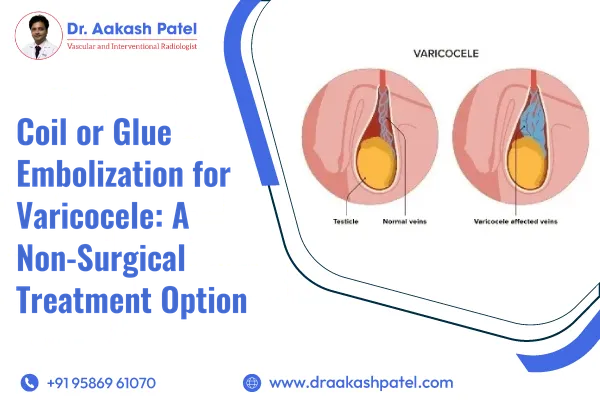
Varicocele is a common yet often overlooked medical condition that affects a significant number of men, especially in their reproductive years. It occurs due to abnormal dilation of veins within the scrotum, leading to impaired blood flow, testicular discomfort, hormonal imbalance, and in many cases, male infertility. Traditionally, varicocele was managed through open surgery; however, treatment now also includes minimally invasive interventional techniques. Today, embolization treatment is an established non-surgical option for varicocele management in suitable patients.
With advancements in interventional radiology, coil embolization and glue embolization treatment may offer many patients a shorter recovery and less discomfort than open surgery, although results vary. These procedures are performed through a small puncture rather than a surgical cut, under imaging guidance. Patients searching for coil embolization treatment in Ahmedabad often ask about these image-guided therapies, their benefits and their risks. Dr. Aakash Patel provides varicocele management planned according to each patient's anatomy and clinical severity. This in-depth guide explains varicocele in detail and describes coil and glue embolization as non-surgical treatment options.
Understanding Varicocele and Its Clinical Impact
What Is Varicocele?
Varicocele is an abnormal enlargement of the pampiniform venous plexus within the scrotum. These veins normally help regulate testicular temperature by draining warm blood away from the testes. When venous valves fail to function correctly, blood begins to collect within these veins, leading to increased temperature and impaired testicular function. Over time, this disrupts sperm production and testosterone balance.
Varicocele may remain asymptomatic for many years, but in progressive cases it leads to testicular discomfort, testicular atrophy, hormonal disturbances, and infertility. Studies consistently associate varicocele with reduced sperm concentration, poor motility, and abnormal morphology. The condition is also linked to chronic pelvic heaviness and psychosocial distress. These clinical implications make early diagnosis and timely medical advice important, so that embolization treatment can be considered where needed.
Diagnosis and Patient Assessment
Accurate diagnosis of varicocele is based on a combination of clinical examination and imaging.
- Physical Examination and Grading: A trained clinician evaluates the scrotum in both standing and supine positions. Varicocele is graded based on visibility and palpability, ranging from small clinically detectable dilatations to large visibly distended veins.
- Doppler Ultrasound Evaluation: Ultrasound with color Doppler is the gold-standard imaging method. It confirms vein dilation, measures reflux duration, and identifies bilateral involvement. Doppler findings also guide treatment planning for coil embolization therapy by mapping the abnormal venous pathways.
- Fertility Assessment: In patients seeking fertility correction, detailed semen analysis and hormonal profiling form part of pre-procedural workup. This allows objective assessment of treatment response following coil embolization and postoperative treatment.
Benefits, Features, and Importance of Embolization Treatment
Modern embolization treatment directly targets the faulty veins responsible for varicocele, without disturbing surrounding tissues. Unlike open surgery, it avoids cutting through the groin or abdominal wall. Blood flow is selectively blocked in abnormal veins while healthy venous drainage remains intact.
- Key Clinical Benefits: Patients usually feel only mild discomfort, there is no surgical incision, and many return to daily activities within a short time. Hospital admission is not usually required. These features may make coil embolization treatment suitable for working professionals and patients seeking minimal physical disruption.
- Functional and Fertility Benefits: Following coil embolization therapy, studies report that many patients show improvement in sperm parameters within three to six months, although results vary. Reduction in scrotal pain and recovery of testicular function may also improve quality of life.
Complete Topic Breakdown: Coil Embolization for Varicocele
What Is Coil Embolization? Coil embolization involves the placement of tiny platinum coils into the abnormal testicular veins under fluoroscopic guidance. These coils produce a localized clot that blocks reverse blood flow. Once the vein is occluded, blood naturally reroutes through healthy venous channels, correcting venous pressure.
- Procedural Technique: The procedure is performed through a small puncture in the groin or neck. A catheter is navigated into the affected gonadal vein using real-time imaging. Once positioned accurately, coils are deployed to seal the vein. The technique aims at controlled occlusion of the vein to reduce the chance of recurrence.
- Clinical Evidence: Published studies report long-term results of coil embolization treatment comparable to surgical ligation, often with a shorter recovery. It is widely adopted as a first-line interventional therapy for varicocele in modern vascular practice.
Glue Embolization Treatment: An Alternative Technique
- Principle of Glue Embolization: Glue embolization treatment uses a medical-grade adhesive to seal the abnormal veins. Unlike coils, the adhesive spreads within the venous channel and solidifies quickly, closing the vein.
- Clinical Application: Glue embolization is particularly useful in complex venous anatomy, recurrent varicocele, or where multiple refluxing channels are present. Precise imaging guidance is essential for controlled delivery.
- Comparative Advantages: The procedure offers rapid vein closure and may reduce fluoroscopy time when performed by experienced operators. In selected cases, glue-based embolization treatment expands therapeutic possibilities where coil placement alone may be technically challenging.
Coil Embolization Treatment in Ahmedabad: Local Access
Access to coil embolization treatment in Ahmedabad has expanded significantly with the rise of dedicated interventional radiology services. These services use angiographic imaging systems, catheter-based techniques, and venous mapping.
Dr. Aakash Patel provides varicocele management based on established interventional protocols. Each patient undergoes personalized imaging evaluation followed by targeted therapy selection—whether based on coil embolization, glue embolization treatment, or a combined strategy. Treatment includes structured follow-up and fertility monitoring when required.
The availability of coil embolization treatment in Ahmedabad reduces dependence on surgical options and allows patients to access non-surgical care closer to home.
Coil Embolization and Postoperative Treatment Care
- Immediate Recovery Phase: After coil embolization and postoperative treatment, patients are typically observed for a short duration, often just a few hours. Mild discomfort at the puncture site or low-grade pelvic pressure may be noted temporarily.
- Return to Daily Activities: Many patients are able to return to their normal daily activities within one to two days, although this varies. Physical exertion restrictions are usually fewer than after open surgery. This makes coil embolization therapy suitable for many patients' daily routines.
- Long-Term Follow-Up: Follow-up Doppler ultrasound is conducted to confirm vein occlusion and evaluate residual reflux. Fertility-oriented patients undergo semen analysis at periodic intervals. Proper postoperative surveillance plays a central role in long-term success following coil embolization and postoperative treatment.
Clinical Outcomes and Long-Term Results
- Symptom Relief: Patients undergoing embolization treatment for varicocele often report relief from scrotal discomfort, reduction in vein prominence, and improvement in daily physical comfort, although results vary.
- Fertility Improvement: Clinical studies report improvement in sperm concentration and motility in many patients following coil embolization treatment. These changes may translate into improved natural conception rates or better outcomes with assisted reproductive techniques.
- Recurrence Control: Studies report that, with careful imaging and correct venous targeting, recurrence rates after coil embolization therapy are low and comparable to microsurgical ligation.
Choosing the Best Non-Surgical Varicocele Treatment Option
Selecting between coil embolization and glue embolization treatment depends on venous anatomy, laterality of disease, prior treatment history, and the physician's assessment. Some patients may benefit from a combined approach for more complex venous networks.
Careful imaging interpretation and procedural planning remain central to outcomes. Patients seeking coil embolization treatment in Ahmedabad may wish to ask about the imaging, the procedure, and the postoperative care that will be provided.
About Dr. Aakash Patel
Dr. Aakash Patel is a Vascular and Interventional Radiologist (MBBS, DNB Radiodiagnosis, FVIR) at KD Hospital, Ahmedabad, who performs embolization treatment for varicocele. Dr. Aakash Patel plans therapy for each patient based on vascular mapping and imaging findings. His clinical approach includes diagnosis, the procedure, and structured follow-up. During consultation he explains the options, their benefits and their risks, including the possible effect on fertility, which varies between patients. Varicocele embolization is a minimally invasive, image-guided procedure, and like all procedures it carries some risk.
Conclusion
Varicocele is a medically significant condition that affects both reproductive health and daily physical comfort. With the evolution of interventional radiology, embolization treatment has become an established non-surgical option. Techniques such as coil embolization, glue embolization treatment, and coil embolization therapy aim to correct abnormal venous reflux. For patients seeking coil embolization treatment in Ahmedabad, image-guided interventions often allow a shorter recovery, although results vary from person to person. Dr. Aakash Patel offers structured treatment pathways that address symptom relief and, where relevant, fertility.
For information on non-surgical coil embolization treatment, consult Dr. Aakash Patel. Call +91 95869 61070 or Book your appointment to discuss your varicocele treatment options.
FAQs